






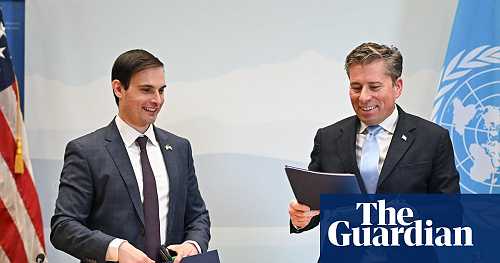
"US adopting specific aid terms for $2bn will cause UN to consider Washington's influence."
 The Humanitarian Aid System Under Siege: A Threat to Global Cooperation
As we begin a new year, the world is facing unprecedented humanitarian crises. From devastating conflicts in Yemen and Afghanistan to climate-induced disasters in various parts of the globe, the need for aid has never been more pressing. However, amidst this backdrop of desperation, a disturbing trend has emerged that threatens to undermine the very fabric of global cooperation: the politicization of humanitarian aid.
The latest development in this worrying narrative is the US's $2 billion pledge to the UN's humanitarian system, accompanied by a laundry list of conditions and demands. While the announcement may have been hailed as "bold and ambitious" by some, experts warn that it could be the "nail in the coffin" for the aid system as we know it.
At its core, this issue is not just about money; it's about values. The US administration's insistence on channeling funds through a pooled fund under the UN's Office for the Coordination of Humanitarian Affairs (OCHA) rather than individual agencies raises concerns about control and accountability. By centralizing power in one body, Washington is effectively dictating how aid should be distributed, leaving little room for flexibility or innovation.
But that's not all. The US has also stipulated that its $2 billion contribution will only go towards 17 priority countries, carefully selected to align with American interests. This means that some of the world's most desperate regions, such as Afghanistan and Yemen, have been excluded from this list. It's a stark reminder that humanitarian aid is no longer about responding to need; it's now about advancing political agendas.
The implications are far-reaching and alarming. By prioritizing its own interests over those of the global community, the US is effectively undermining the principles of humanitarianism. This shift towards a more politicized aid system not only erodes trust but also jeopardizes the very effectiveness of humanitarian responses.
Experts warn that this trend is part of a broader pattern of aid cuts and conditionalities imposed by Western donors. The $2 billion pledge, while welcome, is significantly less than the $3.38 billion provided by the US in 2025 under the previous administration. Moreover, the conditions attached to this funding – including demands for "adaptation" and "efficiency" – are little more than code words for control.
The consequences of this approach will be devastating. As aid budgets shrink and conditionalities multiply, humanitarian organizations will struggle to respond to emerging crises. The UN's ability to coordinate relief efforts will be severely hampered by the need to navigate Washington's demands. And ultimately, it's the most vulnerable populations who will bear the brunt of this politicization.
So what can we do? First and foremost, we must recognize that humanitarian aid is not a zero-sum game. It's not about pitting one country or interest against another; it's about coming together to address shared challenges. We need to reclaim the principles of humanitarianism – neutrality, impartiality, and independence – and ensure that aid is distributed based on need, not politics.
Secondly, we must hold our leaders accountable for their actions. The US administration's approach to humanitarian aid is a stark reminder of the dangers of politicization. We need to demand more from our governments: transparency, accountability, and a commitment to the values that underpin humanitarianism.
Finally, we must support organizations working on the frontlines of humanitarian crises. These individuals and groups are not just providing aid; they're upholding the principles of humanity in the face of adversity. We must amplify their voices, recognize their efforts, and ensure that their work is not undermined by the politicization of aid.
As we navigate this complex landscape, one thing is clear: the future of humanitarian aid hangs in the balance. Will we continue down a path of politicization and conditionalities, or will we reclaim the principles of humanitarianism? The choice is ours.
#Aid #Globaldevelopment #USnews #Trumpadministration #USforeignpolicy #UnitedNations #USAID #USpolitics #Worldnews #Humanitarianresponse #Society #MarcoRubio #Haiti #DemocraticRepublicoftheCongo #Africa #Americas #Sudan #Afghanistan #Yemen
Topic Live
![News/Opinion: Afcon 2025: Equatorial Guinea played against [other team] with a pair banned for abusing the referee after losing despite winning.](/social/site/viewheaderimage?folder=profile_image&tstamp=1742704043&filename=f8a591bd-30a0-412b-a589-5189df6fcca650.jpg)





