






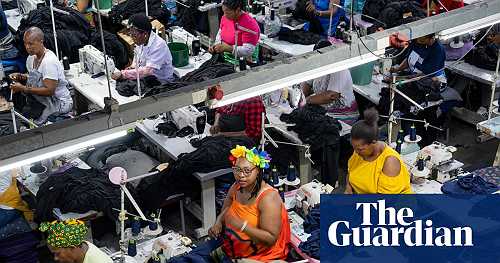
Lesotho garment workers experienced high pressure on their labor during Trump tariffs.
 The Unseen Struggle of Lesotho's Garment Workers: A Story of Resilience and Hope
In a small mountain kingdom nestled in the heart of southern Africa, a silent struggle is unfolding. The garment workers of Lesotho, a country with a population of just 2.3 million, are facing an uncertain future due to the devastating impact of US tariffs imposed by President Donald Trump. As we delve into their story, it becomes clear that these women are not only fighting for their livelihoods but also for their dignity and well-being.
Every morning at 7 am, a sea of hopeful faces gathers outside clothing factories in Maseru, the capital city of Lesotho. These women, mostly between the ages of 25 and 50, have been waiting for what feels like an eternity to be offered work. But since Trump's tariffs came into effect in April 2025, their opportunities have dwindled significantly. The once-thriving garment industry, which employed a staggering 50,000 people at its peak in 2004, is now on the brink of collapse.
Moleboheng Matsepe, a 48-year-old mother of five, shares her heart-wrenching story with us. She lost her full-time job sewing sports leggings for Fabletics in 2023 and has since struggled to make ends meet. Her meager income of just 50 maloti (£2.23) per week is barely enough to cover the basic needs of her family. "The pressure is too much," she confesses, her voice trembling with emotion. "We can't even sleep at night." The weight of responsibility on her shoulders is crushing, and it's a burden that many of these women are forced to bear.
Lesotho's garment industry was once the backbone of the country's economy, thanks in part to the African Growth and Opportunity Act (Agoa), which granted tariff-free access to the US market. However, with Agoa set to expire at the end of September 2025, the future looks bleaker than ever. The trade ministry estimates that there are approximately 36,000 textile workers in Lesotho, a third of whom make clothes for the US. Wages are meager, ranging from as low as 2,582 maloti (£115) per month, but the jobs are still highly prized in a country where unemployment stands at a staggering 30%.
Mapuseletso Makhake, another courageous woman, shares her story of struggle and resilience. She had worked for two months packing Reebok clothing in late 2024 but has since been unable to find steady employment. Her tears flow freely as she speaks about the difficulties she faces in providing for her family, including her 15-year-old daughter's school fees and sanitary towels. "My heart breaks every time," she confesses, "because I don't like the life I am living." The pain of losing her husband in the late 2000s still lingers, and she wishes he were here to share the burden with her.
As we listen to these women's stories, it becomes clear that their struggle is not just about economic survival but also about dignity and self-worth. They are fighting against a system that has failed them, a system that prioritizes profits over people. But despite the odds stacked against them, they remain hopeful. Shelile, a garment worker, advocates for a reduction in tariffs to 10%, the level of Eswatini, Ethiopia, and Kenya, to make Lesotho competitive once again.
As we conclude this story, it's essential to remember that these women are not just statistics or numbers; they are human beings with dreams, aspirations, and families to care for. Their resilience in the face of adversity is a testament to their strength and determination. As we reflect on their struggles, let us also acknowledge the impact of our purchasing decisions and the policies that shape the global economy.
The story of Lesotho's garment workers serves as a poignant reminder of the unseen struggles faced by millions of people around the world. It's a call to action, urging us to rethink our priorities and strive for a more equitable and just society. As we move forward, let us not forget these women and their families, who are fighting for a brighter future, one stitch at a time.
#Lesotho #Trumptariffs #Garmentworkers #Unemployment #DonaldTrump #Tariffs #Worldnews #Africa #SouthAfrica #Women
Topic Live






