

VODOUN LEGBA-
——————-
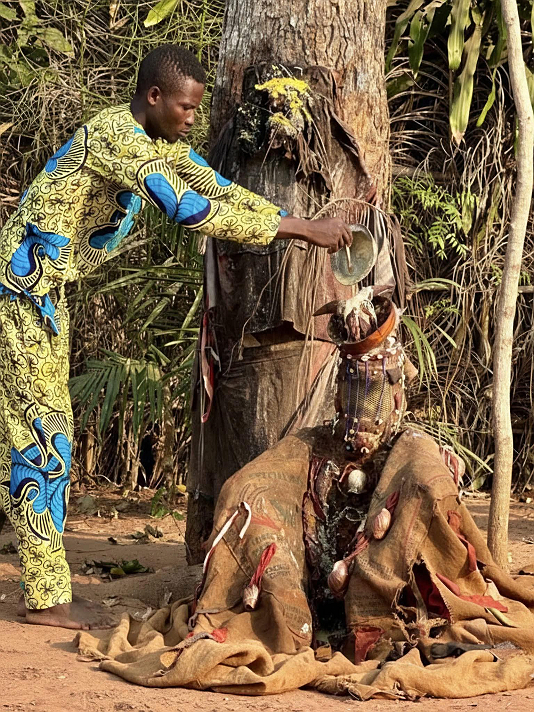
Vodoun Legba (also spelled Legba, Elegba, or Eshu-Legba) is one of the most important deities in the Vodoun (Voodoo) religious tradition of West Africa, particularly among the Fon and Ewe peoples of present-day Benin, Togo, and parts of Ghana. The offering of sacrifices to Legba is deeply rooted in history, cosmology, and daily life, and it cannot be understood as mere ritual violence or superstition, but as a sophisticated spiritual system developed over centuries.
Vodoun itself predates colonialism by many centuries and is one of the oldest continuous religious systems in Africa. Within this worldview, the universe is governed by a supreme creator, often known as Mawu-Lisa, who is distant and unknowable. Communication between humans and this supreme force is made possible through intermediary spirits known as vodun. Among them, Legba occupies a unique position: he is the guardian of thresholds, the messenger between the human and spirit worlds, and the opener of all spiritual pathways.
Because of this role, no ritual, prayer, or ceremony can properly begin without first addressing Legba. To ignore him is to risk spiritual confusion, miscommunication, or misfortune. Sacrifices offered to Legba are therefore acts of respect and necessity, meant to “open the road” between worlds. Historically, these offerings have included palm oil, kola nuts, maize, alcohol, cooked food, and sometimes animals such as chickens or goats, depending on the gravity of the request or the tradition of the community. Human sacrifice, often sensationalised in colonial accounts, was not a defining or routine feature of Vodoun practice and was largely exaggerated or misrepresented by outsiders.
Legba is often depicted in ways that reflect his complex nature. In some traditions, he appears as an elderly man with a walking stick, symbolising wisdom and experience. In others, he is playful, unpredictable, and even mischievous, capable of both protecting and testing humans. This duality reflects a central Vodoun belief: life is balanced by order and chaos, and Legba governs the delicate space between them.
The history of sacrifices to Legba also extends beyond West Africa due to the transatlantic slave trade. Enslaved Africans carried Vodoun beliefs with them to the Americas, where Legba evolved into related figures such as Papa Legba in Haitian Vodou, Exu in Brazilian Candomblé, and Eleguá in Cuban Santería. Despite forced conversion to Christianity, these practices survived by adaptation, symbolism, and secrecy. In the Americas, offerings to Legba continued as acts of cultural resistance and spiritual survival.
Colonial missionaries and administrators often portrayed Vodoun sacrifices as evidence of barbarism, using such narratives to justify domination and cultural suppression. Modern scholarship, however, recognises Vodoun as a coherent ethical and philosophical system, in which sacrifice represents reciprocity between humans and the spiritual world rather than cruelty or fear.
In essence, the sacrifice offered to Vodoun Legba is a historical expression of communication, balance, and respect. It reflects an African understanding of the universe in which humans are not isolated, but part of an interconnected spiritual network. Far from being primitive or sinister, these rituals represent one of West Africa’s most enduring and influential spiritual traditions, shaping religious life across continents and centuries. #benin #fypシ #nigeria
——————-
Vodoun Legba (also spelled Legba, Elegba, or Eshu-Legba) is one of the most important deities in the Vodoun (Voodoo) religious tradition of West Africa, particularly among the Fon and Ewe peoples of present-day Benin, Togo, and parts of Ghana. The offering of sacrifices to Legba is deeply rooted in history, cosmology, and daily life, and it cannot be understood as mere ritual violence or superstition, but as a sophisticated spiritual system developed over centuries.
Vodoun itself predates colonialism by many centuries and is one of the oldest continuous religious systems in Africa. Within this worldview, the universe is governed by a supreme creator, often known as Mawu-Lisa, who is distant and unknowable. Communication between humans and this supreme force is made possible through intermediary spirits known as vodun. Among them, Legba occupies a unique position: he is the guardian of thresholds, the messenger between the human and spirit worlds, and the opener of all spiritual pathways.
Because of this role, no ritual, prayer, or ceremony can properly begin without first addressing Legba. To ignore him is to risk spiritual confusion, miscommunication, or misfortune. Sacrifices offered to Legba are therefore acts of respect and necessity, meant to “open the road” between worlds. Historically, these offerings have included palm oil, kola nuts, maize, alcohol, cooked food, and sometimes animals such as chickens or goats, depending on the gravity of the request or the tradition of the community. Human sacrifice, often sensationalised in colonial accounts, was not a defining or routine feature of Vodoun practice and was largely exaggerated or misrepresented by outsiders.
Legba is often depicted in ways that reflect his complex nature. In some traditions, he appears as an elderly man with a walking stick, symbolising wisdom and experience. In others, he is playful, unpredictable, and even mischievous, capable of both protecting and testing humans. This duality reflects a central Vodoun belief: life is balanced by order and chaos, and Legba governs the delicate space between them.
The history of sacrifices to Legba also extends beyond West Africa due to the transatlantic slave trade. Enslaved Africans carried Vodoun beliefs with them to the Americas, where Legba evolved into related figures such as Papa Legba in Haitian Vodou, Exu in Brazilian Candomblé, and Eleguá in Cuban Santería. Despite forced conversion to Christianity, these practices survived by adaptation, symbolism, and secrecy. In the Americas, offerings to Legba continued as acts of cultural resistance and spiritual survival.
Colonial missionaries and administrators often portrayed Vodoun sacrifices as evidence of barbarism, using such narratives to justify domination and cultural suppression. Modern scholarship, however, recognises Vodoun as a coherent ethical and philosophical system, in which sacrifice represents reciprocity between humans and the spiritual world rather than cruelty or fear.
In essence, the sacrifice offered to Vodoun Legba is a historical expression of communication, balance, and respect. It reflects an African understanding of the universe in which humans are not isolated, but part of an interconnected spiritual network. Far from being primitive or sinister, these rituals represent one of West Africa’s most enduring and influential spiritual traditions, shaping religious life across continents and centuries. #benin #fypシ #nigeria