

Children are not pancakes.
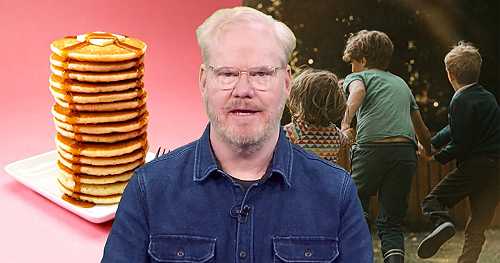 The Pancake Analogy: A Flawed Metaphor for Parenting
As parents, we've all been there - struggling to navigate the uncharted waters of raising our little ones. And in an effort to make sense of it all, we often turn to analogies and metaphors to help us understand this complex journey. But one particular analogy has been getting a lot of airtime lately: comparing parenting to making pancakes.
The idea is simple enough - your first child is like the first pancake you ever made, messy and imperfect, but with each subsequent attempt, you get better at it. The second child is like the second pancake, where you've refined your technique and are more confident in your abilities. And so on. But is this really an accurate representation of parenting?
Comedian Jim Gaffigan, a father of five, recently shared his thoughts on this topic in a humorous yet poignant piece for CBS News. He argues that the pancake analogy is not only oversimplified but also ignores the complexities of birth order theory. According to Gaffigan, each child is unique and presents its own set of challenges, regardless of whether it's your first, second, or third.
Gaffigan's experience as a father of five is a perfect illustration of this point. He notes that his children are not like pancakes at all - they're more like soufflés, unpredictable and prone to collapse. And when you add in the middle child syndrome, where the second child often gets lost in the shuffle, things get even more complicated.
But what's really interesting about Gaffigan's piece is how he uses humor to highlight the absurdity of comparing parenting to something as mundane as making pancakes. He pokes fun at the idea that we're somehow "getting better" at parenting with each subsequent child, when in reality, it's a never-ending learning curve.
So what can we learn from Gaffigan's take on the pancake analogy? For one thing, it's a reminder that parenting is not a science - there are no formulas or recipes for success. Each child is unique, and every family dynamic is different. And rather than trying to fit our experiences into neat little analogies, perhaps we should focus on embracing the chaos and uncertainty of parenting.
Gaffigan's piece also highlights the importance of self-awareness and humility as parents. Rather than pretending that we have it all figured out, we need to be willing to admit when we're struggling and ask for help. And instead of comparing ourselves to others or trying to keep up with societal expectations, we should focus on being present in the moment and loving our children for who they are.
In conclusion, while the pancake analogy may have been a well-intentioned attempt to make sense of parenting, it's ultimately a flawed metaphor that ignores the complexities of family dynamics. By embracing the uncertainty and chaos of parenting, and by being willing to learn from our mistakes, we can become better parents and more compassionate human beings.
So the next time you're tempted to compare your parenting journey to making pancakes, remember Gaffigan's words: "Children are not pancakes." They're unique individuals who deserve our love, attention, and acceptance - imperfections and all.
Topic Live